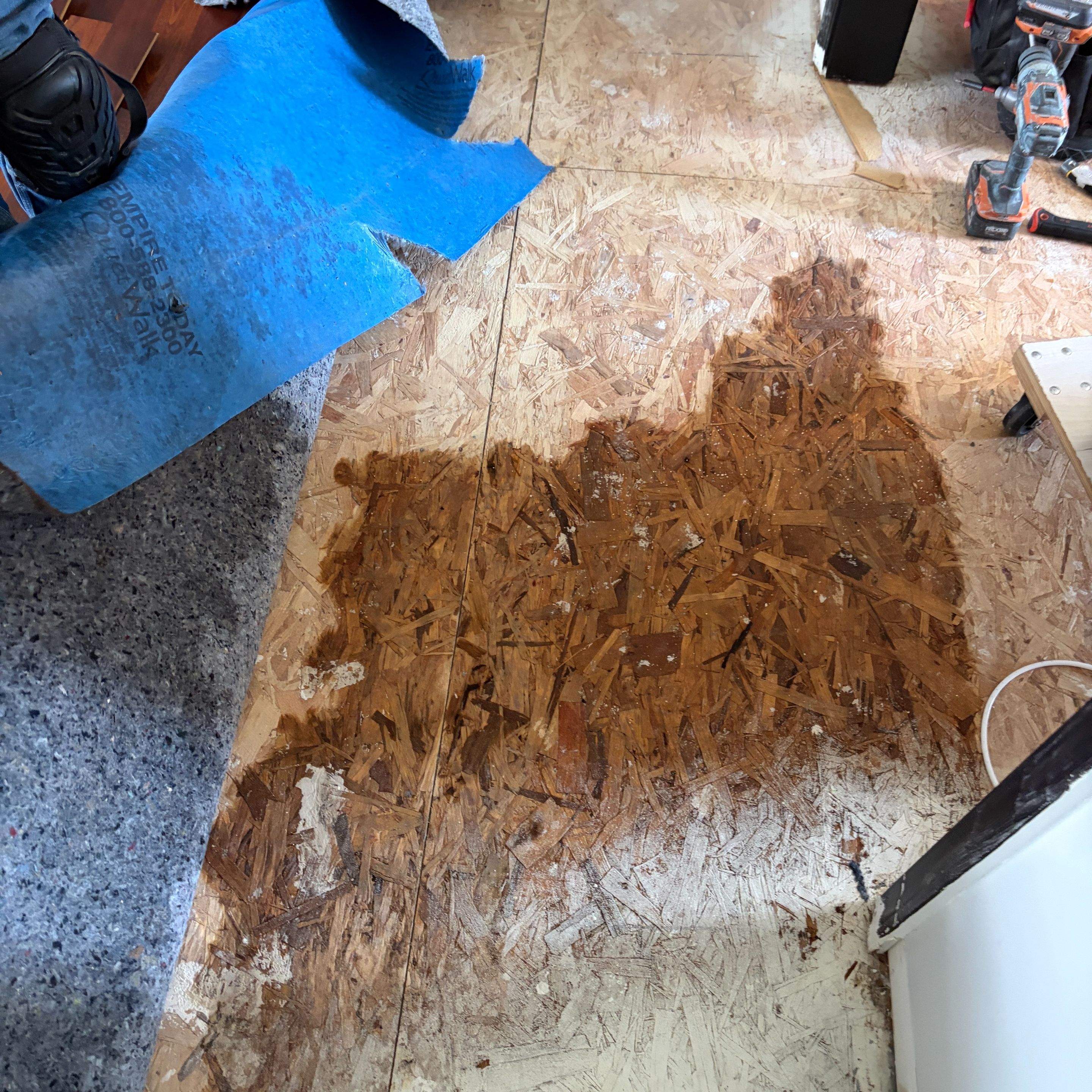
Step 1: Stop the Source and Document Before You Call
- Shut off the main water valve (typically located near the water meter or where the main line enters the home).
- Kill power to affected circuits at the breaker panel if water is near outlets or appliances.
- Take 15 to 20 photos and a 60-second video of every wet surface, including ceilings, baseboards, and contents.
- Note the exact start time. Insurance adjusters in Meridian-Kessler routinely ask, and IICRC drying timelines are measured from this moment.
- Move valuables and electronics to a dry floor at least 6 inches above the water line.
- Pull back area rugs, lift drapes off wet flooring, and prop up upholstered furniture on foil squares or wood blocks to prevent stain transfer.
- Open cabinet doors under sinks and vanities to expose hidden cavities, which dry 40 to 60 percent slower than open rooms.
Step 2: Build a Shortlist of 3 Local Companies
- Search "water damage company near me" or "water damage Meridian-Kessler" and skip paid ads if you want established local crews.
- Verify each company has a physical Meridian-Kessler address, not just a service area pin on Google Maps.
- Confirm a minimum of 50 Google reviews with an average of 4.6 stars or higher.
- Check for reviews mentioning your specific issue (sump pump failure, sewage backup, burst pipe, storm flooding).
- Cross-reference the Better Business Bureau profile and confirm an A or A+ rating with fewer than 3 unresolved complaints in the past 12 months.
- Check the Indiana Secretary of State business registry to confirm the LLC or corporation has been in good standing for at least 3 years.
- Look for Angi, HomeAdvisor, or Nextdoor recommendations from neighbors within a 5-mile radius. Local reputation is harder to fake than national review aggregation.
Step 4: Time the Response and Score the Phone Call
- Call between 2 and 4 companies. Note who answers within 3 rings versus who sends to voicemail.
- Ask for an estimated time of arrival. Acceptable: 60 to 90 minutes in Meridian-Kessler metro, 90 to 120 minutes in outlying areas.
- Ask: "Do you bill my insurance directly or do I pay out of pocket and seek reimbursement?" Direct billing is preferred.
- Ask: "What is your standard drying timeline for a 400 square foot Category 1 loss?" Correct answer: 3 to 5 days with daily moisture readings.
- Disqualify any company that quotes a flat total over the phone without an on-site inspection. Honest scopes require moisture meters and thermal imaging.
- Score each call on a 10-point scale: 3 points for technical accuracy, 3 for ETA commitment, 2 for billing clarity, 2 for credential transparency. Anyone scoring under 7 is off the list.
Step 7: Monitor the Drying Process Daily
- Daily moisture logs should be left on site or emailed every 24 hours.
- Equipment should run continuously. Do not unplug air movers to charge phones or reduce noise.
- Expected drying duration: 3 days (Class 1), 4 to 5 days (Class 2), 5 to 7 days (Class 3), 7 to 14+ days (Class 4 with saturated assemblies).
- Final readings must match unaffected baseline areas within 2 percentage points before equipment is pulled.
- Request a Certificate of Completion signed by the lead technician with final moisture and humidity readings.
- Photograph the equipment placement each morning. Meridian-Kessler Water Restoration crews and reputable competitors expect this and will reposition fans if readings stall for more than 24 hours.
Step 3: Verify Credentials Before You Sign Anything
- Ask for the IICRC certification number for Water Damage Restoration (WRT) and confirm it on the IICRC public registry.
- Request proof of general liability insurance (minimum $1,000,000 per occurrence) and workers compensation.
- Verify the technician arriving on site holds Applied Structural Drying (ASD) certification for jobs involving hardwood, plaster, or multi-room saturation.
- For sewage or flood-source losses, confirm Applied Microbial Remediation Technician (AMRT) certification. Review our sewage cleanup service page for the full Category 3 protocol.
- Reject any company that cannot produce credentials by email within 10 minutes of your request.
- Confirm the firm carries a pollution liability policy (typically $1M to $2M) if Category 2 or 3 water is involved. Standard general liability often excludes microbial claims.
- Ask whether subcontractors will be used for demolition, electrical, or HVAC tie-ins, and request their certification numbers as well.
Step 5: Run the On-Site Inspection Checklist
- Technician should arrive with a truck-mounted or portable extractor, a moisture meter, a thermal camera, and a hygrometer.
- Readings to request in writing: subfloor moisture content (target under 16% for wood), relative humidity (target under 50%), and ambient temperature (70 to 80 F optimal).
- Affected area must be mapped room by room with measurements in square feet and linear feet of affected baseboard.
- Category and Class must be declared on paper. Category 1, 2, or 3. Class 1 through 4. These determine equipment count and timeline.
- Confirm containment plans for any room with mold visible past 10 square feet (per IICRC S520).
- Verify the technician inspects all 4 adjacent rooms, even those that appear dry. Wicking can extend 18 to 24 inches up drywall and 3 to 6 feet across subfloor within 24 hours.
- Ask for a flir thermal scan of the ceiling below any second-floor loss. Trapped moisture in joist cavities is the single most common cause of secondary mold claims in Meridian-Kessler.
Step 8: Red Flags That Should End the Call Immediately
- Door-to-door solicitation after a Meridian-Kessler storm event.
- Demand for full payment upfront or cash-only terms.
- No physical address, no truck signage, no certification numbers.
- Pressure to sign an AOB before inspection.
- Vague verbal estimates with no Xactimate documentation. For deeper guidance on emergency vetting, our 24 hour water damage restoration guide expands on the after-hours checklist.
- Out-of-state license plates or rental trucks with no permanent company decals.
- Refusal to provide a W-9 or EIN for insurance reimbursement paperwork.
Step 6: Review the Written Scope and Pricing
- Demand a Xactimate-formatted estimate. This is the software insurance adjusters use in Meridian-Kessler and across Indiana.
- Line items should include extraction, antimicrobial application, equipment per day (air movers at roughly $25 to $35/day each, dehumidifiers at $75 to $125/day), demolition, and haul-away.
- Typical total for a 400 to 600 square foot Category 1 loss: $2,500 to $6,000. Category 2: $4,000 to $10,000. Category 3 (sewage): $7,000 to $15,000+. See our complete price breakdown for line-item context.
- Confirm the deductible amount and who pays it. Refuse any offer to "waive" or "eat" the deductible. That is insurance fraud under Indiana Code 35-43-5-4.
- Sign a work authorization, not a blanket Assignment of Benefits (AOB), unless you have read every line.
- Verify the scope includes a content pack-out inventory if more than 20 percent of the room contents are affected. Lost-item disputes account for roughly 1 in 4 claim delays.